Quick Answer
A headstone QR code links to an online memorial page with photos, stories, and biographical details. The code is typically etched into stainless steel or stone and mounted near the grave. Static QR codes are strongly recommended because they need to work for decades without depending on any service.
Something quiet is happening in cemeteries. Walk through a newer section and you’ll start to notice small etched plaques near the base of certain headstones, each one holding a QR code. Scan it and you see photographs, a short biography, sometimes an audio clip of the person’s voice. A life that a stone could never hold on its own.
This is a relatively recent shift, and families approach it carefully. The stone itself stays traditional. The code sits discreetly, offered rather than imposed. Anyone who wants more can find it. Anyone who prefers the quiet of the grave itself can simply stand there.
Why families add QR codes to headstones
A headstone has limits. There’s only so much space for text. Longer inscriptions raise costs and change the look of the stone. Many families want to preserve more than names and dates, but they also want to respect the setting.
QR codes give families another option. The stone remains simple. The extra information lives online and stays out of the way unless someone chooses to access it. Families use them to share short biographies, photos from different stages of life, military service details, recorded messages or audio clips, family relationships, cultural or religious context. For relatives spread across different parts of the country, the QR code also helps distant family members feel more connected during a visit, even one happening for the first time.
How they actually work
The concept is simple. A QR code links to a webpage. That webpage contains the memorial content. A visitor scans with their phone camera and the page opens.
Three physical components sit behind the setup. The QR code itself, usually engraved on metal, stone, or ceramic, depending on the family’s preference and the cemetery’s rules. The placement on the memorial, which families typically choose to be discreet (near the base of the stone, on a companion plaque, or on the back). And the linked digital page, which can range from a simple text-only memorial to a more detailed archive with media. The QR code doesn’t store the information; it stores the link. That distinction matters for both longevity and control.
Static vs dynamic, for memorials
For headstones, static is strongly recommended. Permanence matters more here than for almost any other QR code use case. The engraved code needs to work decades from now, without depending on any company staying in business or a subscription staying paid.
Link to a memorial page you control (or on a platform with clear long-term commitments), and update the content there as needed. The engraved code stays permanent; the page content can evolve as more family members contribute over the years. The static-vs-dynamic decision in detail treats the question at length.
What goes on the memorial page
Content varies widely. Some families keep it brief. Others build detailed archives over the years.
A short biography in plain language is the most common starting point: where the person grew up, their work, family life, interests. Many families keep it under 500 words so it reads easily on a phone in the cemetery. Photos help visitors connect quickly: a portrait, a family photo, an image from a meaningful moment. Use high-resolution images but compress them so the page loads quickly on a phone over cellular.
Short written memories from friends and relatives add depth, usually curated by one family member to avoid clutter. Recorded messages, interviews, or audio of the person’s voice add another layer; compress these too and host them somewhere reliable. Some families include timelines, military service details, or cultural and religious notes that explain traditions connected to the grave.
The page should feel composed, not exhaustive. Most visitors are reading for a few minutes, not an afternoon.
Privacy choices
A QR code is public by nature. Anyone who visits the grave can scan it. Families should decide what level of openness feels appropriate.
Three common approaches cover most preferences. A fully public page lets anyone with the link view the content. An unlisted page doesn’t appear in search results but is accessible through the QR code; this often strikes a balance between accessibility and privacy. A password-protected page asks visitors to enter a password before viewing, which adds friction (especially for older visitors) but provides the strongest control.
Whatever choice is made today, families should also think about future access. Who manages the page if the original creator is no longer available? Hosting account credentials, domain ownership, and edit access should be documented and shared with at least one other family member.
Durability and materials
The digital page matters, but the physical QR code has to survive outdoors for decades.
Cemeteries expose materials to sunlight, rain, snow, temperature swings, and lawn maintenance equipment. The materials that hold up best are laser-etched stainless steel (resists corrosion and fading, scans cleanly across most styles), anodized aluminum (lightweight and affordable, but may fade in strong sun over many years), direct stone or granite engraving (matches the headstone’s look, requires precise execution to keep the code scannable), and glazed ceramic tiles (hold detail well and resist weathering, usually mounted on a metal backing).
Before installing anything, check cemetery rules. Some cemeteries limit attachments or require approval for additional plaques. Ask first.
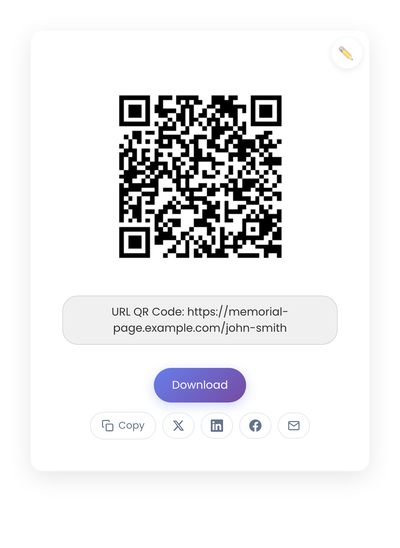
A static QR code that the engraver can take directly to production. The destination URL is encoded in the pattern; no subscription service sits in between.
Placement at the gravesite
A few practical choices increase the chance the code actually gets used. Keep it within easy scanning height; codes flush with the ground are hard to scan and prone to dirt. Maintain clear contrast between the code and its background. Avoid spots that collect dirt, grass clippings, or standing water after rain.
Most families place the QR code on a companion plaque near the base of the headstone. This keeps the main inscription untouched while adding the digital element nearby. The stone still does the heavy lifting; the code is the option, not the answer.
Creating the code
Decide first where the memorial page will live, who can edit it over time, and whether the URL will be stable for decades. The page hosting decision matters more than the QR code generator does.
- Once the memorial page is live, generate the code on StackQR and send the high-resolution SVG to your engraver.
- Download in SVG format; it scales cleanly for engraving without resolution loss.
- Test the result on multiple phones in different lighting conditions.
- Coordinate with the memorial provider on file format requirements and size.
The code is generated in the browser, so no account or personal information is needed to create it. For engraving specifically, the tutorial covers error-correction settings that help recover scans when part of the engraved pattern fills with dirt or moss over time.
Long-term ownership
A headstone lasts decades. The QR code’s destination should aim for the same lifespan.
A few questions decide whether the setup will outlast its first decade. Who owns the domain or the hosting account? How are the hosting fees paid over time, and are they on an auto-pay that will keep working after the creator? Where are the login details stored, and who else can access them? What happens if the page needs updates years from now?
Some families also include a short text URL engraved discreetly near the QR code, so future visitors have a backup if scanning becomes difficult in some technological future where QR codes are no longer the default reading format.
Common mistakes
A few patterns are worth avoiding.
Overloading the page. Too much content slows loading and overwhelms visitors. Short sections read better on a phone in a quiet outdoor space.
Choosing fragile materials. Cheap plastics and stickers fade quickly outdoors. Engraving costs more upfront but reduces future problems.
Ignoring cemetery rules. Some cemeteries remove unauthorized items without notice. Always check guidelines before installation.
Relying on short-term services for hosting. Memorial content on a free service that may shut down risks vanishing exactly when the family most needs it to persist. Use hosts known for long-term commitments.
Cultural and generational notes
Not every visitor feels comfortable scanning a QR code at a gravesite. Some prefer traditional visits. Others appreciate the added context. Families often navigate this by keeping the QR code discreet, ensuring the stone still stands on its own, and treating the digital page as entirely optional.
A headstone QR code done well is quiet, durable, and patient. The stone still carries the name. The code waits in case someone wants to know more.