The whole tradeoff in three sentences
Static QR codes encode data directly in the pattern, work forever, cost nothing, and keep your data private. Dynamic QR codes redirect through a service, allowing you to change destinations and track scans, but require subscriptions and stop working if the service shuts down. For most people, static codes are the right choice.
Every commercial QR code generator pushes dynamic codes hard. That’s not an accident. Dynamic codes require a subscription, and subscriptions are how those companies stay in business. The pitch is always the same: editable destinations, scan analytics, the flexibility to change the URL after printing. It sounds like the smarter choice, and for a small number of use cases it actually is.
For most people, though, the quieter option wins. Static QR codes cost nothing, work forever, keep your data private, and don’t depend on any company staying in business. They lose the analytics dashboard and the ability to redirect after printing, and that’s the entire tradeoff. Understanding which side of that tradeoff your situation actually sits on is worth more than any feature comparison.
What a static QR code is
A static QR code encodes information directly into its black-and-white pattern. When someone scans it, their phone reads the data embedded in the code itself. No internet connection for the decoding step, no server lookup, no middleman.
Think of static QR codes like printed text. The information is physically present in the pattern. A URL QR code contains the actual URL characters encoded in the squares. A WiFi QR code contains your network name, security type, and password right in the pattern.
The practical consequences: static codes work without any server or service, can’t be edited after creation, function forever without maintenance, have no built-in tracking, and cost nothing. Once you print one, it works for as long as the physical code exists. Nothing to renew, no subscription to maintain, no company that has to stay in business for your code to keep functioning.
What a dynamic QR code is
A dynamic QR code doesn’t contain your destination URL directly. Instead, it contains a short redirect URL that points to a server. When someone scans, their phone visits the redirect server, which then forwards them to your actual destination.
The indirection creates flexibility: since the redirect server controls where scanners end up, you can change the destination anytime without reprinting the code.
The practical consequences: dynamic codes contain a redirect URL rather than the actual destination, require an active service to keep functioning, can be edited anytime, typically include scan tracking and analytics, require ongoing subscription fees, and stop working if the service shuts down.
How each works under the hood
When you create a static QR code for https://example.com/menu, the generator converts that URL into a specific pattern of modules (the black and white squares). The pattern itself is the data. Any reader following the QR code standard (ISO/IEC 18004) decodes the same pattern to the same URL. Static codes from one generator are interchangeable with codes from another.
When you create a dynamic QR code for the same destination, the service generates a short URL like qr-service.com/abc123 and encodes that into the pattern. The scan path becomes: phone decodes the pattern, gets qr-service.com/abc123, visits that URL, the service records the scan (time, location, device type), and the service redirects to example.com/menu. The service maintains a database linking abc123 to your actual destination. Changing where abc123 points changes where scanners end up, without touching the printed code.
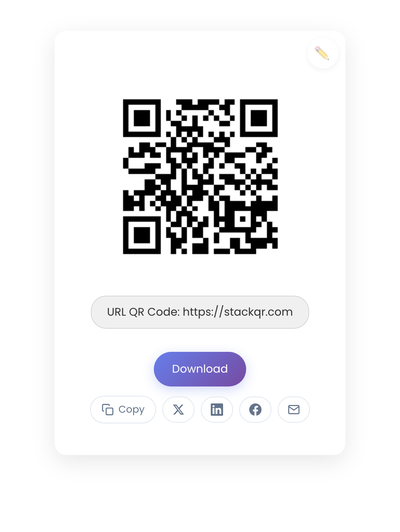
A static QR code with the destination URL encoded directly into the pattern. No redirect service sits between the scanner and the destination, which is what gives static codes their indefinite lifespan.
Cost
Static QR codes are genuinely free. The encoding algorithm is standardized and public. Browser-based generators create them without any server infrastructure. Total cost: zero, forever. Unlimited codes, no accounts, no subscriptions.
Dynamic QR codes require infrastructure (servers for redirects, databases for destinations, systems for analytics), and providers pass that cost to you. Free tiers usually cap codes or scans, brand the codes heavily, or restrict the destination edit features. Paid plans run roughly $5-50 per month for more codes and scans on a branded domain. Enterprise tiers run $100-500 per month for unlimited codes, API access, and team features.
The catch: if you stop paying, your codes stop working. Every dynamic QR code printed on packaging, signage, or marketing materials becomes non-functional when the subscription lapses.
When static is the right pick
Static QR codes work best for information that either won’t change or links to a URL you control.
Permanent printed materials are the obvious fit. Business cards, product packaging, vehicle wraps, building signage: anywhere the code will exist for years. Static codes guarantee functionality regardless of what happens to any QR service company. A restaurant QR code menu that links to your own website works well as a static code; update the webpage content anytime, the QR code doesn’t need to change.
Privacy-sensitive content belongs on static codes. WiFi passwords, vCard contact details, and private URLs shouldn’t route through third-party servers. Static codes keep this data between you and whoever scans.
One-time uses fit naturally too. Event tickets, conference badge codes, RSVP forms, and wedding photo sharing all have a specific fixed purpose. Static encoding is simpler and more reliable.
Budget-conscious projects (nonprofits taking donations through payment apps, small business websites, personal projects like labeling storage boxes) often can’t justify ongoing subscription costs for QR functionality they could get for free.
When dynamic earns its keep
Dynamic QR codes make sense when their unique capabilities (editability and tracking) provide clear value.
Frequently changing destinations on permanent materials. If you print codes that need to point at different URLs monthly or quarterly, dynamic codes save reprinting costs. Marketing campaigns with rotating promo code landing pages are the most common example.
Detailed analytics requirements. Dynamic codes can track total scan count, time and date of each scan, geographic location, device type and OS, unique vs repeat scanners. If that data drives business decisions, dynamic codes provide it automatically.
A/B testing through the same printed code. Some businesses test different landing pages without reprinting; dynamic codes enable that.
Recoverable errors. Printed a code pointing to the wrong URL? Dynamic codes let you fix the mistake. Static codes require reprinting.
The hybrid approach most businesses end up using
A lot of situations work well with a static QR code pointing to a URL you control. The QR code is static and will always go to that URL. The page at that URL changes whenever needed: new menu items, price updates, seasonal specials, redesigned content. You get the permanence of static codes (no subscription needed), the flexibility of updateable content (change the webpage), and full control (you own the website).
The one limit: you can’t change the URL itself. If your domain changes, your QR codes break. For most businesses with stable web presence, this isn’t a real concern.
Misconceptions worth correcting
“Static codes are low quality.” Quality depends on the generator, not the type. Both static and dynamic codes can be any resolution.
“Dynamic codes scan faster.” Both scan at the same speed. Pattern complexity comes from the encoded data length, not the code type. A dynamic code encoding a short redirect URL might actually have a simpler pattern than a static code encoding a long URL.
“Static codes can’t be tracked.” Static codes don’t have built-in tracking, but you can add tracking parameters to the URL. A code linking to example.com/menu?source=flyer tells you which placement drove traffic in your analytics, without needing a dynamic service.
“Dynamic codes are more secure.” Neither type is inherently more secure. Both can link to legitimate or malicious destinations. Dynamic codes actually introduce an additional point of trust (the redirect service) that could theoretically be compromised.
A short decision framework
A few questions usually settle it.
Will the destination URL change? If no, static is simpler. If yes but you control the webpage, static linking to your own URL handles it. If yes and the URL itself will change frequently, dynamic earns its keep.
Do you need scan analytics? Basic counts and source tracking can come from URL parameters in a static code. Detailed device/location/time data needs dynamic.
What’s your budget? If zero ongoing cost matters, static. If you can justify ongoing fees, either works.
How long will these codes be in use? For years or permanently, static (no subscription dependency). For months on a specific campaign, either works.
Does data privacy matter? For sensitive information, static. For public destinations, either works.
Making the choice
For most individuals and small businesses, static QR codes handle the job. They cost nothing, work forever, and require no technical management. Point them at URLs you control, and you get flexible content without ongoing fees.
Dynamic codes serve specific use cases: heavy analytics, frequently changing destinations without stable URLs, enterprise requirements. If you don’t have those needs, you’re paying for capabilities you won’t use.
The practical approach: start with static. If you later discover you genuinely need editing or detailed analytics, dynamic services are available. The reverse (moving from dynamic dependency to static simplicity) is harder once you’ve printed codes that rely on a subscription.
Making the printed code last
Static permanence only pays off if the physical code holds up too. Codes printed too small degrade faster as ink spreads or fades. High contrast, generous quiet-zone margins, and larger-than-minimum sizes all extend lifespan, especially outdoors where small imperfections become scanning problems over time.
Material matters as much as size. Vinyl decals handle outdoor weather. Laser engraving works on metal or plastic equipment labels. UV-resistant ink slows sun fade. Laminated prints survive moisture. Match the material to where the code will live: a code mounted behind a desk in a stable indoor environment outlasts the same code on a window facing the parking lot. Surfaces people touch constantly, spots near hinges or moving parts, and anywhere with direct sun or moisture all shorten a code’s working life.
Two habits close the loop. Test the printed result, not just the digital file: scan in bright light, in low light, from the typical viewing distance, on more than one phone. And keep a simple inventory of where your codes exist and what they point to. A spreadsheet listing location, destination URL, creation date, and purpose takes minutes to set up. When a website refresh changes URL structures years later, you know exactly which codes need redirects instead of finding out from customers reporting dead links.
Technical specifications, briefly
For those who want the details. Static QR code capacity caps at 7,089 numeric characters, 4,296 alphanumeric, 2,953 byte-mode, and 1,817 Kanji/Kana characters. Most URLs and data fit comfortably; long URLs can use shorteners, but that reintroduces a redirect dependency.
Both static and dynamic codes support the four error correction levels (L, M, Q, H), allowing roughly 7% to 30% damage recovery. Higher correction means larger codes but more reliability against scratches or dirt.
Minimum scannable size depends on scanning distance and print quality, not on code type. About 2cm (0.8 inches) works for close-up scanning; larger sizes for greater distances.
Bottom line
Static QR codes encode data directly, work forever, cost nothing, and keep information private. They’re the right choice for permanent applications, privacy-sensitive content, and budget-conscious projects. Create one with our free static QR code generator.
Dynamic QR codes redirect through services, enabling editability and analytics at the cost of subscriptions and third-party dependencies. They suit situations requiring frequent destination changes or detailed scan tracking.
Most users are well-served by static codes pointing to URLs they control. The webpage content can change; the QR code doesn’t need to. That hybrid approach captures the benefits of both worlds without ongoing costs or dependencies.